
Beta Distributional Neural Networks for Bounded Outcome Prediction
DOI:
https://doi.org/10.62933/xv1e8490Keywords:
Beta Distribution, Neural Networks, Bounded outcome, Synthetic data, Colon CancerAbstract
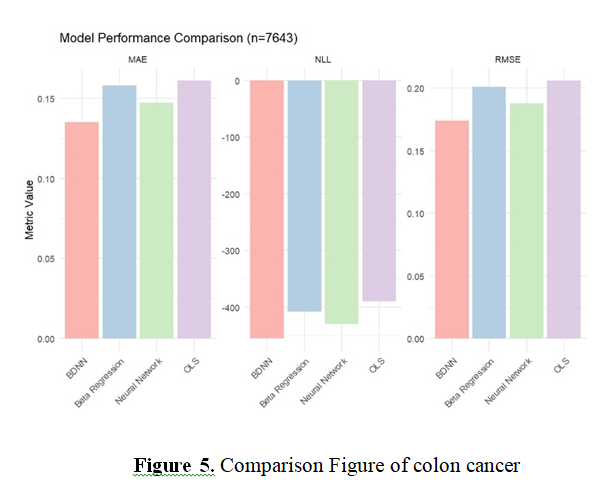
This paper presents a new neural modeling system, named the Beta-Distributional Neural Network (BDNN), which is aimed at predicting restricted outcomes over the open unit interval (0,1). In contrast to the traditional neural networks, which produce deterministic point estimates, the proposed model provides direct predictions of the two shape parameters of the beta distribution ( and ), and thus, predictive mean and uncertainty can be estimated simultaneously. This is to achieve statistical coherence and computational stability, which is trained through maximum likelihood estimation by minimizing the negative log-likelihood. It is tested on BDNN using synthetic data sets, which have been built based on the data-generating curves, both linear and nonlinear, as well as a real-world colon cancer drug-response dataset. It makes comparative studies using ordinary least squares regression, classical beta regression and traditional feedforward neural network. Empirical findings prove that BDNN always has better predictive accuracy in terms of reduced RMSE and MAE values and has better probabilistic calibration based on negative log-likelihood. These results indicate the adequacy of incorporating distributional modelling with deep neural structures in the prediction of limited outcomes in medical and applied research areas.
References
[1] Ahmed, S. F., Alam, M. S. B., Hassan, M., Rozbu, M. R., Ishtiak, T., Rafa, N., Mofijur, M., Shawkat Ali, A., & Gandomi, A. H. (2023). Deep learning modelling techniques: current progress, applications, advantages, and challenges. Artificial Intelligence Review, 56(11), 13521-13617.
[2] Bouraya, S., & Belangour, A. (2024). A comparative analysis of activation functions in neural networks: unveiling categories. Bulletin of Electrical Engineering and Informatics, 13(5), 3301-3308.
[3] Bunel, R., Lu, J., Turkaslan, I., Torr, P. H., Kohli, P., & Kumar, M. P. (2020). Branch and bound for piecewise linear neural network verification. Journal of Machine Learning Research, 21(42), 1-39.
[4] Cangalovic, V. S., Thielke, F., & Meine, H. (2024). Comparative evaluation of uncertainty estimation and decomposition methods on liver segmentation. International journal of computer assisted radiology and surgery, 19(2), 253-260.
[5] Chilimbi, T., Suzue, Y., Apacible, J., & Kalyanaraman, K. (2014). Project adam: Building an efficient and scalable deep learning training system. 11th USENIX symposium on operating systems design and implementation (OSDI 14),
[6] Cribari-Neto, F., & Zeileis, A. (2010). Beta regression in R. Journal of statistical software, 34(1), 1-24.
[7] Dureja, A., & Pahwa, P. (2019). Analysis of non-linear activation functions for classification tasks using convolutional neural networks. Recent Patents on Computer Science, 12(3), 156-161.
[8] Ferrari, S., & Cribari-Neto, F. (2004). Beta regression for modelling rates and proportions. Journal of applied statistics, 31(7), 799-815.
[9] Glorot, X., & Bengio, Y. (2010). Understanding the difficulty of training deep feedforward neural networks. Proceedings of the thirteenth international conference on artificial intelligence and statistics,
[10] Gneiting, T., & Katzfuss, M. (2014). Probabilistic forecasting. Annual Review of Statistics and Its Application, 1(1), 125-151.
[11] Gupta, A. K., & Nadarajah, S. (2004). Handbook of beta distribution and its applications. CRC press.
[12] Jais, I. K. M., & Ismail, A. R. (2019). Adam optimization algorithm for wide and deep neural network. Knowledge Engineering and Data Science, 2(1), 10.
[13] Kieschnick, R., & McCullough, B. D. (2003). Regression analysis of variates observed on (0, 1): percentages, proportions and fractions. Statistical modelling, 3(3), 193-213.
[14] Kim, S., Yu, Z., Kil, R. M., & Lee, M. (2015). Deep learning of support vector machines with class probability output networks. Neural Networks, 64, 19-28.
[15] Mobiny, A., Yuan, P., Moulik, S. K., Garg, N., Wu, C. C., & Van Nguyen, H. (2021). Dropconnect is effective in modeling uncertainty of bayesian deep networks. Scientific reports, 11(1), 5458.
[16] Neal, P., Eric, C., Borja, P., & Jonathan, E. (2011). Distributed optimization and statistical learning via the alternating direction method of multipliers. Foundations and Trends® in Machine learning, 3(1), 1-122.
[17] Paolino, P. (2001). Maximum likelihood estimation of models with beta-distributed dependent variables. Political Analysis, 9(4), 325-346.
[18] Paszke, A., Gross, S., Massa, F., Lerer, A., Bradbury, J., Chanan, G., Killeen, T., Lin, Z., Gimelshein, N., & Antiga, L. (2019). Pytorch: An imperative style, high-performance deep learning library. Advances in neural information processing systems, 32.
[19] Rasp, S., Pritchard, M. S., & Gentine, P. (2018). Deep learning to represent subgrid processes in climate models. Proceedings of the national academy of sciences, 115(39), 9684-9689.
[20] Roustaei, N. (2024). Application and interpretation of linear-regression analysis. Medical Hypothesis, Discovery and Innovation in Ophthalmology, 13(3), 151.
[21] Sigrist, F. (2022). Gaussian process boosting. Journal of Machine Learning Research, 23(232), 1-46.
[22] Simon, H. A. (2000). Bounded rationality in social science: Today and tomorrow. Mind & Society, 1(1), 25-39.
[23] Smithson, M., & Verkuilen, J. (2006). A better lemon squeezer? Maximum-likelihood regression with beta-distributed dependent variables. Psychological methods, 11(1), 54.
[24] Srivastava, N., Hinton, G., Krizhevsky, A., Sutskever, I., & Salakhutdinov, R. (2014). Dropout: a simple way to prevent neural networks from overfitting. The journal of machine learning research, 15(1), 1929-1958.
Downloads
Published
Issue
Section
License
Copyright (c) 2026 Ahmed Naziyah Alkhateeb (Author)

This work is licensed under a Creative Commons Attribution-NonCommercial-ShareAlike 4.0 International License.
Licensed under a Creative Commons Attribution 4.0 International License: https://creativecommons.org/licenses/by/4.0/


