
The Log (t+1) Weibull Distribution: A New Flexible Model for Slow Peaking Survival Data
DOI:
https://doi.org/10.62933/fyf9f761Keywords:
Log-Weibull,, Gradually rising,, Sharp jump,, Nonlinear behavior,, Pancreatic cancer,Abstract
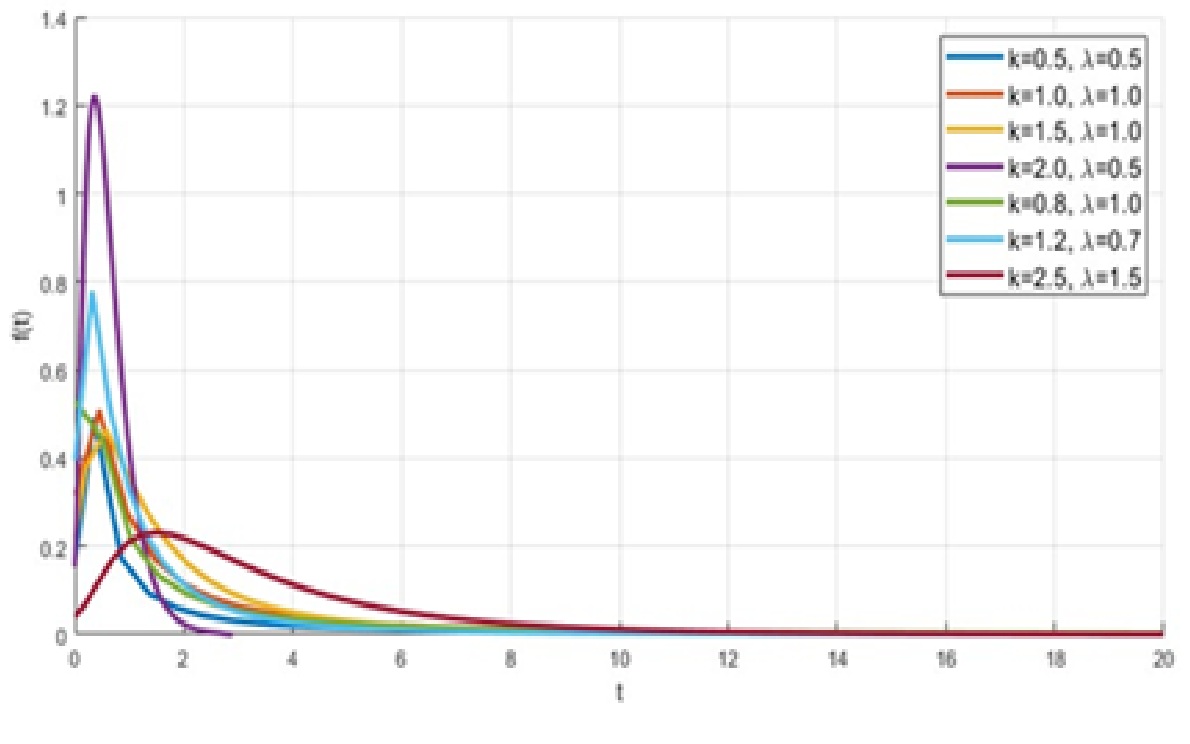
This paper aims to develop a new distribution, known as the Log-Weibull distribution, as a modification of the basic Weibull distribution by replacing the time variable t with the logarithmic variable Log (1+t). This aims to achieve a more accurate and realistic representation of survival data with nonlinear behavior. The statistical properties of the new distribution were analyzed and compared with the Weibull distribution in terms of density functions, survival, and hazard functions. Trade-off measures (AIC, AICc, BIC, HQ, SHWTZ) and the mean square error (MSE) criterion were also used to measure the goodness of fit. The results showed that the Log-Weibull distribution exhibits a smoother behavior of the probability density function, starting from zero at t=0 and gradually rising to a peak representing the most probable time of the event, unlike the Weibull, which may exhibit a sharp jump at the beginning. Furthermore, the proposed distribution offers high flexibility in representing multivariate survival data over time, leading to increased accuracy.
References
1. Klakattawi, H.S., 2022. Alpha power Kumaraswamy Weibull distribution: Properties and applications to cancer data. Computational Intelligence and Neuroscience, 2022, pp.1–14. Available at: https://doi.org/10.1155/2022/5745788
2. Li, Y., Zhang, H., Wang, J. and Chen, X., 2024. Application of Weibull parametric survival model in cancer survival analysis. BMC Medical Research Methodology, 24, p.87. Available at: https://doi.org/10.1186/s12874-024-02214-7
3. Shebib, H.S.M., Ali, B.K. and Naserallah, M.W., 2021. Use the best fitted model for estimating with the number of infections with the COVID-19 virus under fuzzy environment. International Journal of Agricultural and Statistical Sciences, 17(1), pp.201–206.
4. Sindhu, T.N. et al., 2024. Distributional properties of the entropy transformed Weibull distribution and applications to various scientific fields. Scientific Reports, 14, Article 31827. Available at: https://doi.org/10.1038/s41598-024-83132-w
5. Sapkota, L.P. et al., 2025. New bounded unit Weibull model: Applications with quantile regression. PLOS ONE.
6. Afify, A.Z., Alsultan, R., Alghamdi, A.S. and Mahran, H.A., 2025. A new flexible Weibull distribution for modeling real life data: Improved estimators, properties, and applications. AIMS Mathematics, 10(3), pp.5880–5927. Available at: https://doi.org/10.3934/math.2025270
7. Najm, A.A. and Ali, B.K., 2025. Survival function estimation for Weibull distribution based on granular hesitant fuzzy set. Central Asian Journal of Mathematical Theory and Computer Sciences, 6(1), pp.26–43. Available at: https://cajmtcs.centralasianstudies.org/index.php/CAJMTCS
8. Schober, P. and Vetter, T.R., 2018. Correlation coefficients: Appropriate use and interpretation. Anesthesia & Analgesia, 126(5), pp.1763–1768. Available at: https://doi.org/10.1213/ANE.0000000000002864
9. Sarkar, K., Chowdhury, R. and Dasgupta, A., 2019. Analysis of survival data: Challenges and algorithm-based model selection. Journal of Clinical and Diagnostic Research, 13(12), pp.LE01–LE07. Available at: https://doi.org/10.7860/JCDR/2019/43268.13358
10. Rangoli, S., Kumar, R. and Patel, A., 2025. Modified Weibull distribution: Properties and applications in survival data analysis. Cureus, 17(1), e326188. Available at: https://doi.org/10.7759/cureus.326188
11. Alsulami, H.H., Almetwally, E.M. and Alharbi, R., 2025. A new generalization of the Weibull distribution with statistical properties and applications. Mathematics, 13(20), p.3262. Available at: https://doi.org/10.3390/math13203262
12. Gong, Y., Liu, Z., Zhang, L. and Wang, X., 2025. A transformed inverse Weibull distribution with statistical properties and applications. PLOS ONE, 20(5), e0335555. Available at: https://doi.org/10.1371/journal.pone.0335555
13. Klakattawi, H.S., 2022. Alpha power Kumaraswamy Weibull distribution: Properties and applications to cancer data. Computational Intelligence and Neuroscience, 2022, pp.1–14. Available at: https://doi.org/10.1155/2022/5745788
Downloads
Published
Issue
Section
License
Copyright (c) 2026 Bashar Khalid Ali, Sackineh Shamil Jasim (Author)

This work is licensed under a Creative Commons Attribution 4.0 International License.
Licensed under a Creative Commons Attribution 4.0 International License: https://creativecommons.org/licenses/by/4.0/


