
The Impact of Financial Sustainability and Structural Transformation on Investments Using QARDL Model Optimized by the Marine Predator Algorithm
DOI:
https://doi.org/10.62933/33vvah15Keywords:
Marine Predators Algorithm (MPA); QARDL Model; Investment Dynamics; Fiscal Sustainability; Structural Transformation; Iraqi EconomyAbstract
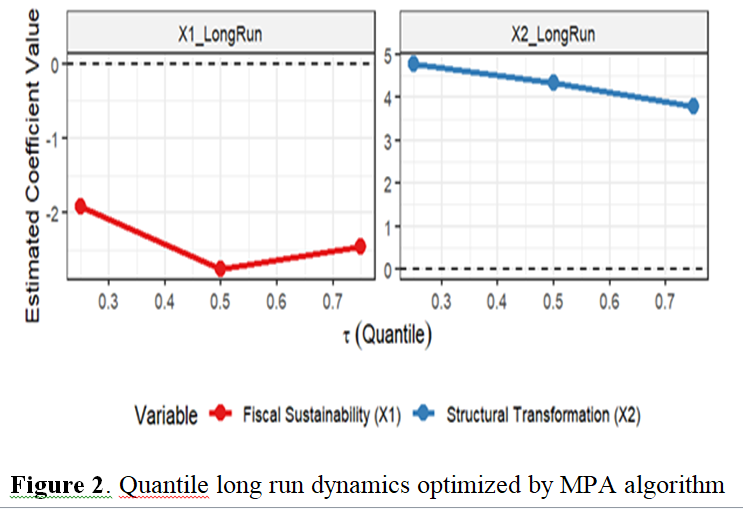
The present article explores the asymmetric dynamic effects of fiscal sustainability and structural transformation on the private investment in Iraq over the timeframe (2008-2025) in a QARDL model optimized by Marine Predators Algorithm (MPA). The approach incorporates the use of MPA to improve on the efficiency of best lag choice followed by the estimation of the parameters to overcome non-convexity in the quantile loss function. The findings indicate asymmetric cointegration and a fiscal crowding out in both senses, and in both the structural transformation is revealed as the major source of driving in the low-credit period. The findings indicate that the emerging investments are very susceptible to inflation and parallel exchange rate shocks and therefore require specific monetary interventions. The paper suggests the use of the QARDL-MPA due to the high ability to predict nonlinear time series in economically uncertain settings.
References
[1] Abd Elminaam, D. S., Nabil, A., Ibraheem, S. A., & Houssein, E. H. (2021). An efficient marine predators algorithm for feature selection. IEEE Access, 9, 60136-60153.
[2] Al-Betar, M. A., Awadallah, M. A., Makhadmeh, S. N., Alyasseri, Z. A. A., Al-Naymat, G., & Mirjalili, S. (2023). Marine Predators Algorithm: A review. Archives of Computational Methods in Engineering, 30(5), 3405-3435.
[3] Al-qaness, M. A., Ewees, A. A., Fan, H., Abualigah, L., & Abd Elaziz, M. (2020). Marine Predators Algorithm for forecasting confirmed cases of COVID-19 in Italy, USA, Iran and Korea. International Journal of Environmental Research and Public Health, 17(10), 3520.
[4] Al-Sayyed, R., AlSayyed, A. B. R., Makhadmeh, S. N., Sanjalawe, Y., & Khasawneh, B. M. (2025). A novel particle marine predator optimizer for gene selection health problem. F1000Research, 14, 1275.
[5] Aribowo, W., & Shehadeh, H. A. (2025). A comparative study of metaheuristic optimization algorithms in solving engineering designing problems. Journal of Robotics and Control (JRC), 6(4), 1885-1898.
[6] Castillo-Mateo, J., Asín, J., Cebrián, A. C., Gelfand, A. E., & Abaurrea, J. (2023). Spatial quantile autoregression for season within year daily maximum temperature data. The Annals of Applied Statistics, 17(3), 2305-2325.
[7] Central Bank of Iraq (CBI). Annual Statistical Bulletin, Statistics and Research Department, Baghdad, Iraq. Retrieved from https://cbiraq.org
[8] Cho, J. S., Kim, T. H., & Shin, Y. (2015). Quantile autoregressive distributed lag Modelling Framework. Journal of Econometrics, 188(1), 281-300.
[9] Demirhan, H. (2020). dLagM: An R package for distributed lag models and ARDL bounds testing. PLOS ONE, 15(2), e0228812.
[10] Faramarzi, A., Heidarinejad, M., Mirjalili, S., & Gandomi, A. H. (2020). Marine Predators Algorithm: A nature-inspired metaheuristic. Expert Systems with Applications, 152, 113377.
[11] Hsu, T. K. (2016). The stock price of China and the exchange rate: A quantile autoregressive distributed lag model. WSEAS Transactions on Business and Economics, 13, 471-481.
[12] Investing.com. Brent Oil Futures Historical Data. Retrieved from https://sa.investing.com/commodities/brent-oil
[13] Koenker, R., & d'Orey, V. (1987). Computing regression quantiles. Journal of the Royal Statistical Society: Series C (Applied Statistics), 36(3), 383-393.
[14] Kripfganz, S., & Schneider, D. C. (2023). ARDL: Estimating Autoregressive Distributed Lag and Equilibrium Correction Models. The Stata Journal, 23(1), 192-219.
[15] Kripfganz, S., & Schneider, D. C. (2023). ardl: Estimating autoregressive distributed lag and equilibrium correction models. The Stata Journal, 23(4), 983-1019.
[16] Ministry of Planning. (2024). Annual Abstract of Statistics. Central Organization for Statistics and Information Technology (COSIT). Baghdad, Iraq. [Online]. Available at: http://www.cosit.gov.iq
[17] Nabi, A. A., Ahmed, F., Tunio, F. H., Hafeez, M., & Haluza, D. (2025). Assessing the impact of green environmental policy stringency on eco-innovation and green finance in Pakistan: A quantile autoregressive distributed lag (QARDL) analysis for sustainability. Sustainability, 17(3), 1021
[18] Rai, R., Dhal, K. G., Das, A., & Ray, S. (2023). An inclusive survey on Marine Predators Algorithm: Variants and applications. Archives of Computational Methods in Engineering, 30(5), 3133–3172. https://doi.org/10.1007/s11831-023-09897-x
[19] Solarin, S. A., & Bello, M. O. (2020). The impact of shale gas development on the US economy: Evidence from a quantile autoregressive distributed lag model. Energy, 205, 118004.
[20] Tian, Y., et al. (2020). Likelihood-based quantile autoregressive distributed lag models and its applications. Journal of Applied Statistics, 47(11), 1973-1991.
[21] Ullah, S., Ozturk, I., & Sohail, S. (2021). The asymmetric effects of fiscal and monetary policy instruments on Pakistan’s environmental pollution. Environmental Science and Pollution Research, 28(6), 7450-7461.
[22] Yeboah, K. E., Feng, B., Jamatutu, S. A., Nyarko, F. E., & Justice, N. D. (2026). The interplay of environmental taxes, energy consumption and economic growth: A decarbonization pathway towards sustainable development. Environment, Development and Sustainability, 1-24..
[23] Zhu, S., et al. (2022). Environmental impact of the tourism industry in China using novel QARDL model. Economic Research-Ekonomska Istraživanja, 35 (1), 3663-3689.
Downloads
Published
Issue
Section
License
Copyright (c) 2023 Mariam Jumaah Mousa , Munaf Yousif Hmood (Author)

This work is licensed under a Creative Commons Attribution-NonCommercial-ShareAlike 4.0 International License.
Licensed under a Creative Commons Attribution 4.0 International License: https://creativecommons.org/licenses/by/4.0/


